

The problem behind the headline
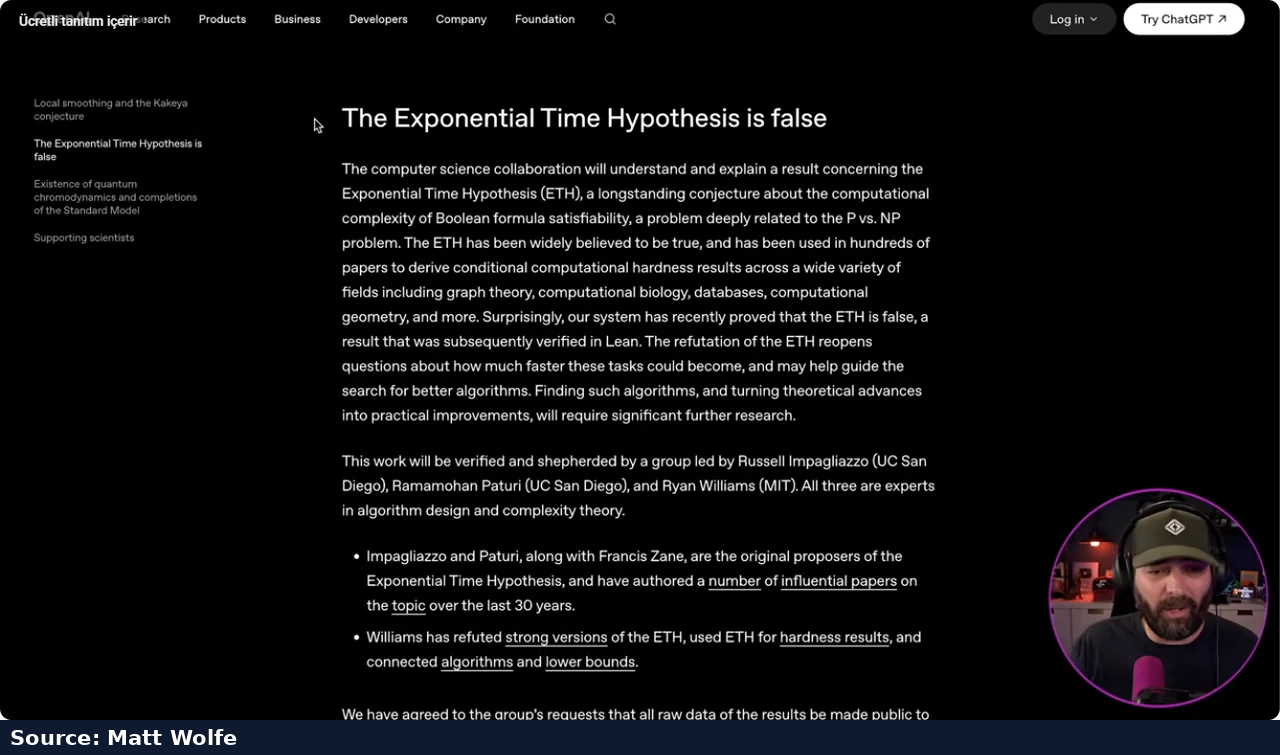
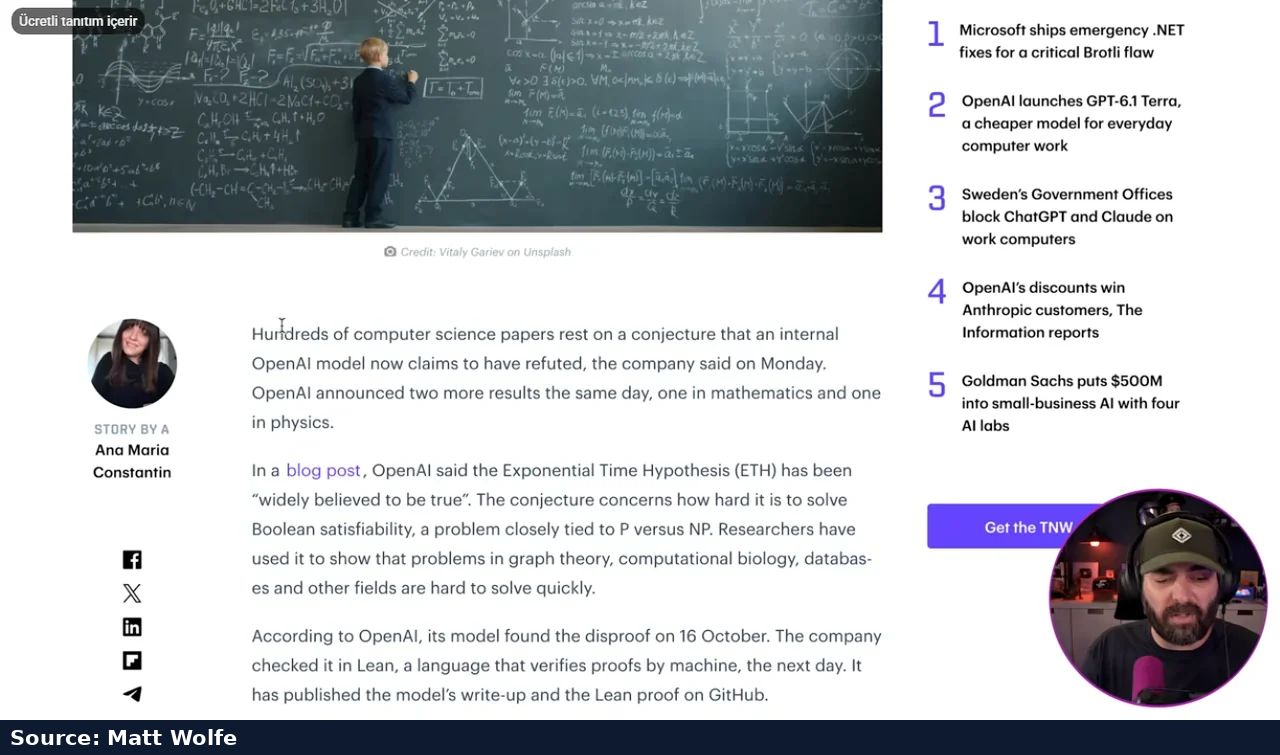
Matt Wolfe closes his weekly report with OpenAI’s claim that an internal model disproved the Exponential Time Hypothesis, or ETH. This is a conjecture about the difficulty of certain Boolean satisfiability problems: deciding whether true/false choices can satisfy a collection of logical rules.
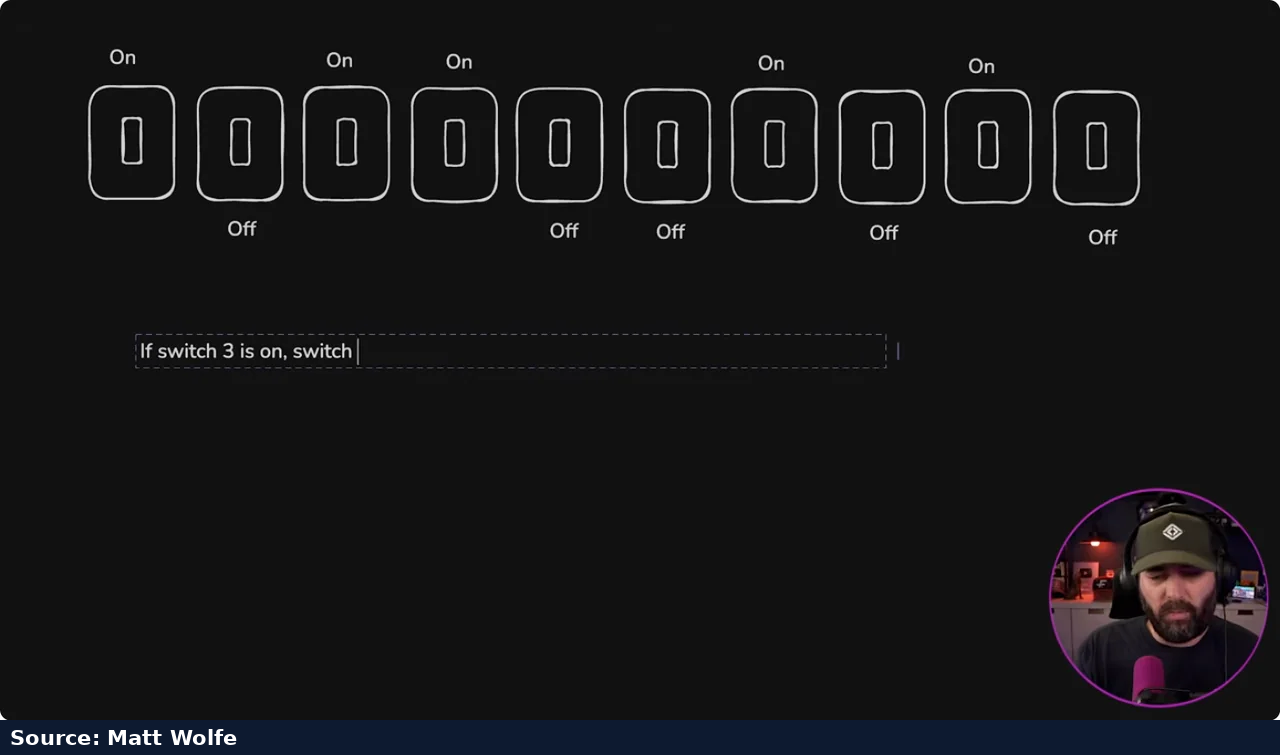
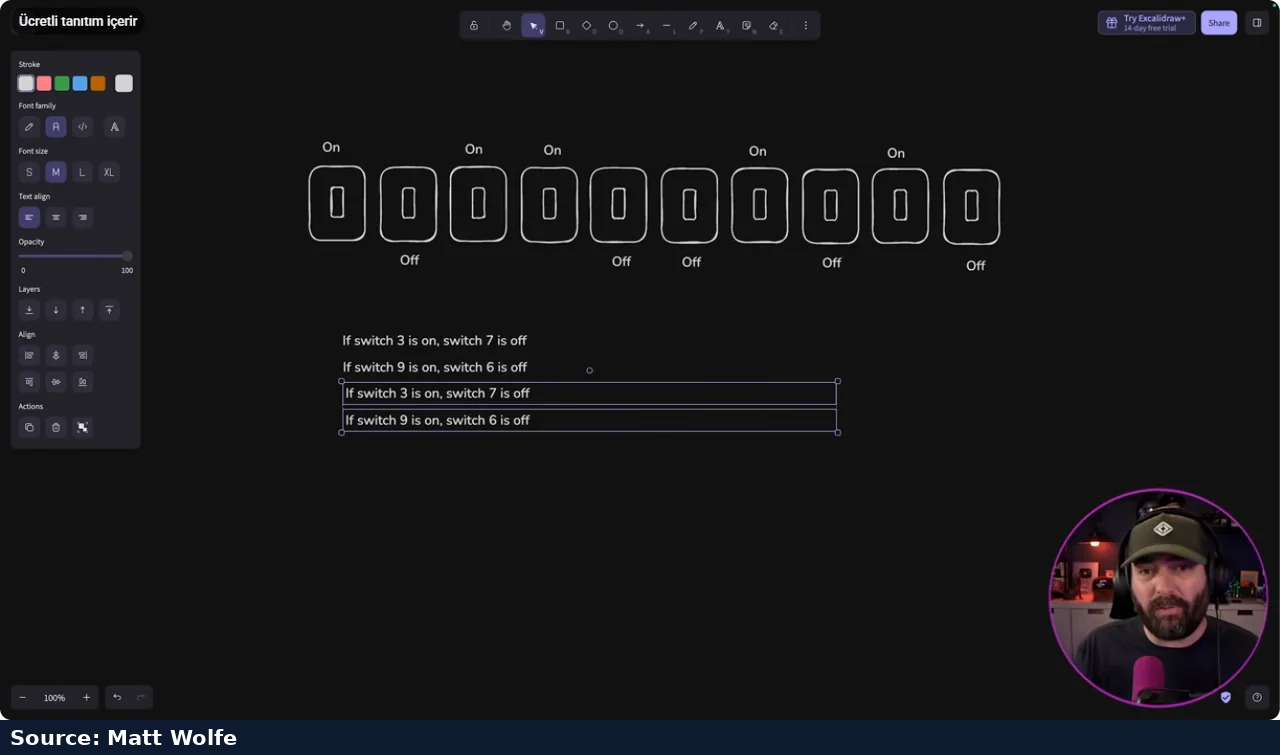
Wolfe uses light switches as an analogy. Ten switches have 1,024 combinations, roughly a thousand; thirty have over a billion. Each extra switch doubles the possible configurations. The analogy explains explosive growth. It is not a complete mathematical statement of ETH.
Why researchers care about the assumption
The video describes ETH as a roughly 25-year-old assumption used in hundreds of papers. Researchers use such assumptions to derive conditional statements: if the assumption holds, particular problems cannot be solved within a stated running-time bound.
A refutation changes what those conditional arguments tell us about actual computational limits. It does not make every earlier theorem or paper meaningless. In particular, the logical statement “if ETH, then X” must be distinguished from asserting X without that assumption.
What Lean checks
Wolfe says the proof was verified in Lean. Lean is a formal proof system: arguments are written with precise definitions and checked against formal rules. His “spell checker for mathematics” comparison is meant to make this easier to picture.
Formal verification and scientific understanding are related but distinct. Readers still need to know the exact statement, definitions, assumptions and connection to the intended problem. A checked formal artifact is not a substitute for experts explaining the result’s scope.
What the official announcement says
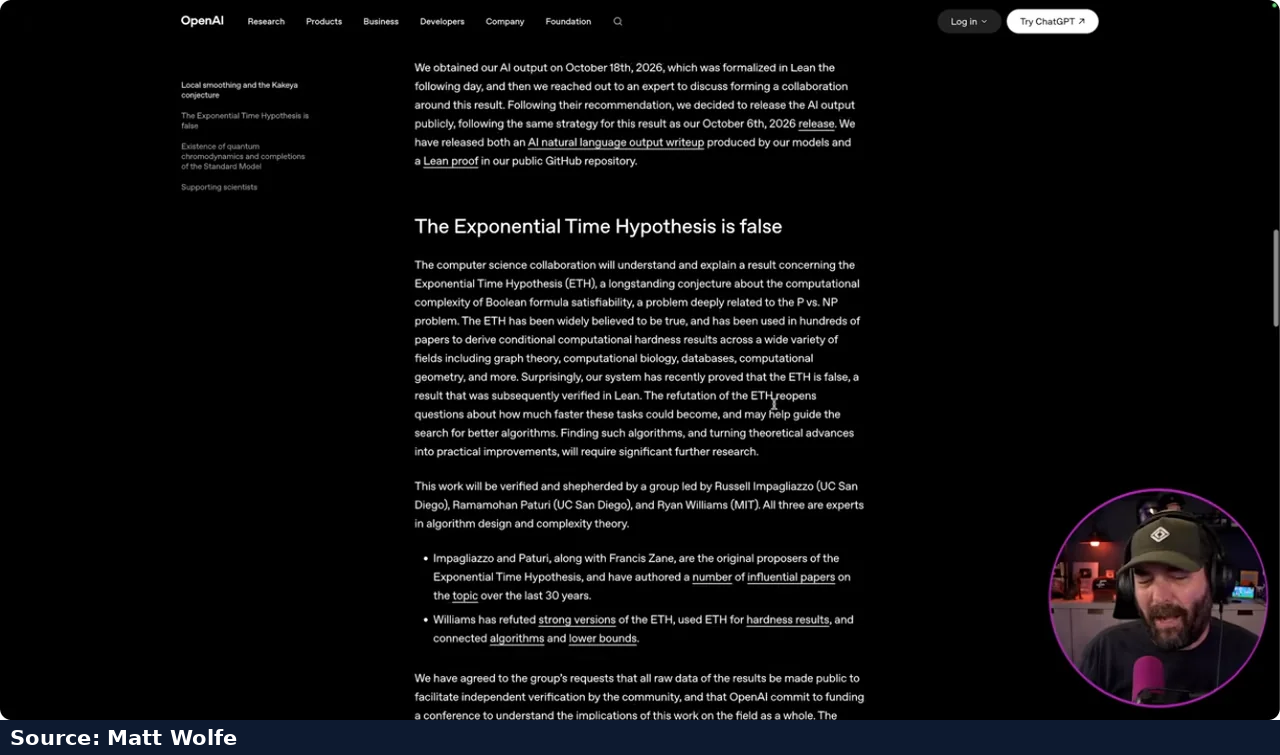
OpenAI reports a natural-language disproof dated 16 October 2026 and a Lean formalization dated 17 October. The announcement describes public artifacts and an independent group led by Russell Impagliazzo, Ramamohan Paturi and Ryan Williams.
The group is intended to examine and explain the result. This article checked the announcement on 1 November 2026; it has not reproduced the proof or independently verified its mathematics. The company presents the materials as research output requiring community understanding, not as a ready-to-install speed upgrade.
Theory and usable algorithms are different stages
Wolfe sees the report as a possible example of AI contributing knowledge beyond familiar benchmark tasks. He explicitly says he is not a mathematician and offers a simplified explanation.
A result about asymptotic complexity concerns how work grows as inputs grow. Turning it into faster scheduling, chip design, databases or software tools requires further research and implementation. It also does not by itself settle P versus NP. The useful response is to follow the released proof, independent examination and subsequent algorithmic work, keeping the company’s claim separate from practical outcomes.